
Most home gyms do not fail because of bad equipment.
Most home gym setup mistakes come from poor planning, layout issues, and inefficient use of space.
They fail because the setup makes training harder than it should be.
At first, everything feels right. You bring in a rack, some weights, maybe a bench or a machine. The space looks complete and you are motivated to use it. But after a few weeks, small frustrations start to show up.
You bump into equipment during lifts. You hesitate to do certain exercises because there is not enough space. Plates end up stacked wherever they fit. Transitions between movements feel slow and awkward. Nothing is broken, but nothing feels smooth.
That is where most home gyms start to fall off.
The issue is not effort. It is friction.
When your setup creates friction, every workout becomes slightly harder to start and slightly harder to finish. Over time, that adds up. Workouts become less consistent, equipment gets underused, and the gym you were excited about becomes something you work around instead of something that works for you.
The reality is that almost all of this is preventable.
A well-built home gym is not just about what you own. It is about how everything works together so that training feels natural, efficient, and repeatable every single day.
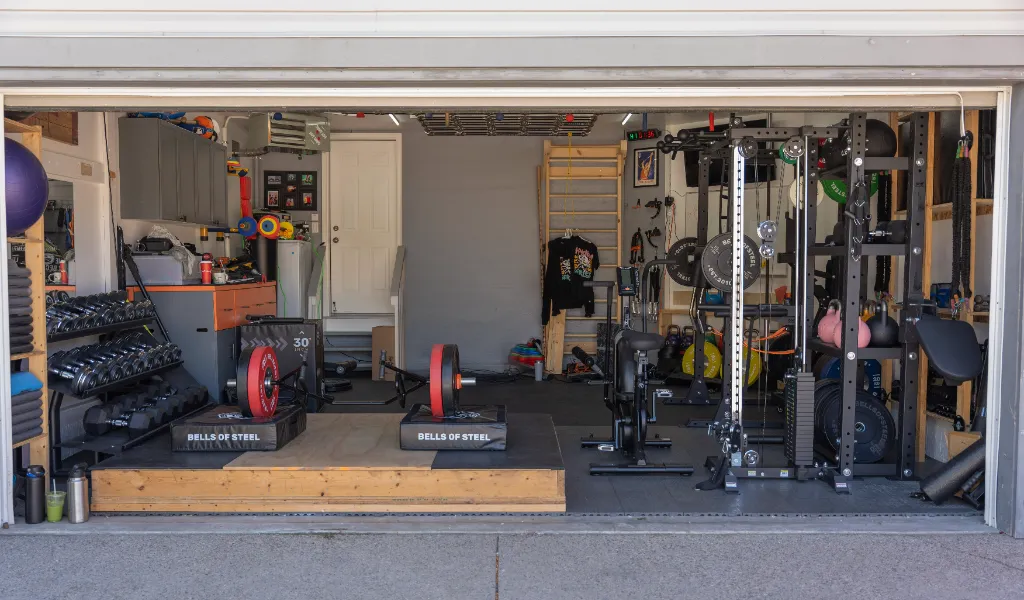
Why Small Mistakes Turn Into Big Problems
Home gym setup mistakes rarely show up immediately.
They build slowly through repetition.
At first:
- Everything fits
- The space feels usable
- The setup seems complete
But once you start training consistently:
- Movement patterns expose limitations
- Equipment placement creates friction
- Workflow slows down
This is when small issues become real problems.
For example, a rack placed slightly too close to a wall may seem fine on day one. But over time, every re-rack, every plate change, and every set under fatigue becomes more difficult than it should be.
A lack of storage might not matter early on. But as your gym grows, loose plates, dumbbells, and attachments create clutter that slows everything down and adds unnecessary noise.
This is why setup matters more than equipment.
Mistake #1: Common Home Gym Setup Mistake — Building Around Equipment
One of the biggest mistakes is building your gym around what you buy instead of how you actually train.
It is easy to focus on equipment:
- Buying a rack because it looks essential
- Adding machines because they seem useful
- Filling space instead of planning it
But your gym should be built around your training style.
Ask yourself:
- What movements do I perform most often?
- How much space do those movements actually require?
- What equipment supports those movements best?
If your setup does not align with your training, your workouts will always feel inefficient, no matter how good your equipment is.
Mistake #2: Underestimating Space for Movement
Most people measure space based on equipment footprint, not movement. Many home gym layout mistakes happen when equipment is placed without considering movement flow.
That is where problems begin.
For example:
- A barbell extends beyond the rack during use
- Dumbbell movements require room to move freely
- Lunges, rows, and presses take up more space than expected
If you only plan for where equipment sits:
- You will feel cramped
- Movements will be restricted
- Certain exercises will get avoided
Always plan for how you move, not just where equipment fits.
Mistake #3: Treating Flooring as Optional
Flooring is often skipped early to save time or money.
That decision shows up quickly during training:
- More noise and vibration
- Less stability during lifts
- Increased wear on equipment
- Harder, less controlled workouts
Flooring is not just protection. It is performance.
Your Best Home Gym Flooring for Beginners (2026 Guide) should be treated as a foundational part of your setup, along with your Home Gym Flooring Maintenance & Cleaning (Keep Your Gym Looking New 2026) article to keep that performance consistent over time.
Mistake #4: Letting Storage Become an Afterthought
Storage is one of the biggest differences between a functional gym and a frustrating one.
Without proper storage:
- Plates end up stacked randomly
- Dumbbells stay on the floor
- Attachments become difficult to find
- Setup time increases between exercises
This creates constant friction during workouts.
A well-organized gym:
- Moves faster
- Feels cleaner
- Reduces noise
- Improves focus
This is why your Best Weight Plate Storage for Home Gyms (2026 Guide) and Best Home Gym Cable Attachments (2026 Guide) play such an important role in overall setup quality.
Mistake #5: Ignoring Equipment Interaction
Most people evaluate equipment individually instead of as part of a system.
Problems happen when:
- Machines block movement paths
- Benches interfere with rack usage
- Storage overlaps with lifting space
Your gym is not a collection of items. It is a working environment.
Every piece of equipment should:
- Have a defined position
- Work with surrounding equipment
- Support movement instead of restricting it
Mistake #6: Prioritizing Quantity Over Usability
More equipment does not make your gym better.
In most cases, it makes it worse.
Too much equipment:
- Reduces usable space
- Limits movement
- Creates clutter
- Slows down workouts
A smaller, well-planned gym will always outperform a crowded one.
Focus on:
- Versatility
- Quality
- Frequency of use
Mistake #7: Not Planning for Progression
Your gym should support your future, not just your starting point.
Without planning:
- You outgrow equipment quickly
- You are forced to rearrange everything
- You spend more replacing than improving
Instead:
- Leave space for expansion
- Choose versatile equipment
- Build with long-term use in mind
This is where your Best Foldable Power Rack for Garage Gyms (2026 Guide) and Best Cable Machines for Home Gyms (2026 Guide) support a setup that grows with you.
Mistake #8: Overlooking Noise and Environment
Your environment directly affects how often you train.
If your gym is:
- Too loud
- Too hot
- Too cramped
It becomes harder to stay consistent.
Noise, airflow, and layout all play a role in how your gym feels.
This is where your Best Soundproofing Options for Home Gyms (Reduce Noise 2026 Guide) and your noise reduction strategies come into play.
Mistake #9: Rushing the Setup Process
Trying to finish your gym too quickly leads to poor decisions.
Rushing results in:
- Inefficient layout
- Unnecessary purchases
- Overlooked details
A better approach:
- Build in phases
- Test your setup
- Adjust based on real use
The best home gyms are built over time, not all at once.
Mistake #10: Not Thinking of Your Gym as a System
The biggest mistake is treating each part of the gym separately.
Your gym is a system made up of:
- Flooring
- Layout
- Storage
- Equipment
- Environment
When these pieces work together:
- Workouts feel smoother
- Transitions become faster
- The space feels controlled
When they do not:
- Everything feels harder than it should
That difference is what separates a good-looking gym from one that actually works.
FAQ
What is the biggest mistake when setting up a home gym?
Not planning layout and movement space before buying equipment is the most common and impactful mistake.
How do I know if my gym setup needs improvement?
If movements feel restricted, workouts feel slow, or you avoid certain exercises, your setup likely needs adjustment.
Should I focus on equipment or layout first?
Layout always comes first. A well-planned space makes any equipment more effective.
Can I fix mistakes without starting over?
Yes. Most issues can be improved by adjusting layout, storage, and equipment placement.
Why does my home gym feel cluttered?
Clutter is usually caused by lack of storage and poor organization, not too much equipment.
How can I make my gym more efficient?
Focus on flow, spacing, and making sure every piece of equipment has a clear purpose and place.
Final Thoughts
Avoiding home gym setup mistakes is not about perfection. It is about building a space that removes friction from your training.
Most people think the solution is better equipment. In reality, the biggest improvements come from how your gym is set up. When layout, flooring, storage, and equipment placement are aligned, everything feels easier. You move more freely, transitions become faster, and your workouts feel more focused.
Start with your foundation. Flooring is one of the most important upgrades you can make because it affects stability, noise, and overall performance. Your Best Home Gym Flooring for Beginners (2026 Guide) should be one of the first references you use when building or improving your setup. From there, maintaining that surface with your Home Gym Flooring Maintenance & Cleaning (Keep Your Gym Looking New 2026) article ensures your gym continues to perform the way it should.
Organization is what brings everything together. A clean, structured gym eliminates wasted time and unnecessary noise. Your Best Weight Plate Storage for Home Gyms (2026 Guide) and Best Home Gym Cable Attachments (2026 Guide) help create a system where everything has a place and nothing gets in your way.
From there, your equipment choices should support your long-term goals. Articles like Best Home Gym Equipment for Apartments (Low Noise + Space-Saving Options) – 2026 Guide, Best Foldable Power Rack for Garage Gyms (2026 Guide), and Best Cable Machines for Home Gyms (2026 Guide) all contribute to building a setup that is flexible, efficient, and built to grow with you.
This is where everything connects.
A great home gym is not just about what you own. It is about how your environment supports your training every time you step into it. When your setup works with you instead of against you, consistency becomes easier, workouts become more efficient, and your results improve over time.
Build your gym with intention, and it will continue to work for you long after the initial setup is complete.